
How Chiropractic Care Changes as Your Child Grows: A Petaluma Parent’s Guide from Newborn to Teen
Parents in Petaluma ask us a version of the same question all the time. My baby is three weeks old. Is chiropractic care really for someone that small? Then a few years later, the same parent asks something else. My daughter is thirteen and plays two sports. Is this still the same thing?
The answer to both is yes. The honest answer is also that it looks very different at each age.
At Titan Chiropractic we care for whole families from Petaluma, Penngrove, Cotati, Rohnert Park, and across Sonoma County. A newborn and a teenager might both get checked in the same hour. What we are looking for is the same in both cases. How we look for it, and how we adjust, changes a lot.
Here is what that looks like, stage by stage.
The one question we ask at every age
Your body is designed to work at one hundred percent. Your brain and your body talk all day long through the nervous system. That is your brain, your spinal cord, and every nerve that branches off of them. That system runs the things you never think about. Digestion. Sleep. Focus. Muscle tone. Heart rhythm.
Picture the breaker box in your garage. Plug in too much at once and a breaker trips. Nothing is broken. The circuit just needs to be restored.
A nervous system can get overloaded in a similar way. When stress piles up faster than a body clears it, function slips. Symptoms are signals. They are the check engine light, not the engine.
So at every age, from the first week of life on up, pediatric chiropractic care at Titan is asking the same question. How much stress is this nervous system carrying, and where is it stuck?
What changes with age is the size of the person, the kind of stress they carry, and how little pressure it takes to help their system shift.
Newborns and the first few weeks
A brand new baby has already been through a lot. Pregnancy positioning, labor, and birth all put real load on a very small spine and neck.
Checking a newborn is quiet work. Baby usually stays in your arms, or lies on the table while you stand right there with a hand on them. We feel along the spine with fingertip pressure and look for the spots that are not moving the way the rest are.
Then the adjustment itself is about as much pressure as you would use to check whether a tomato at the Petaluma farmers market is ripe. That is the whole thing. Gentle, specific, and over quickly.
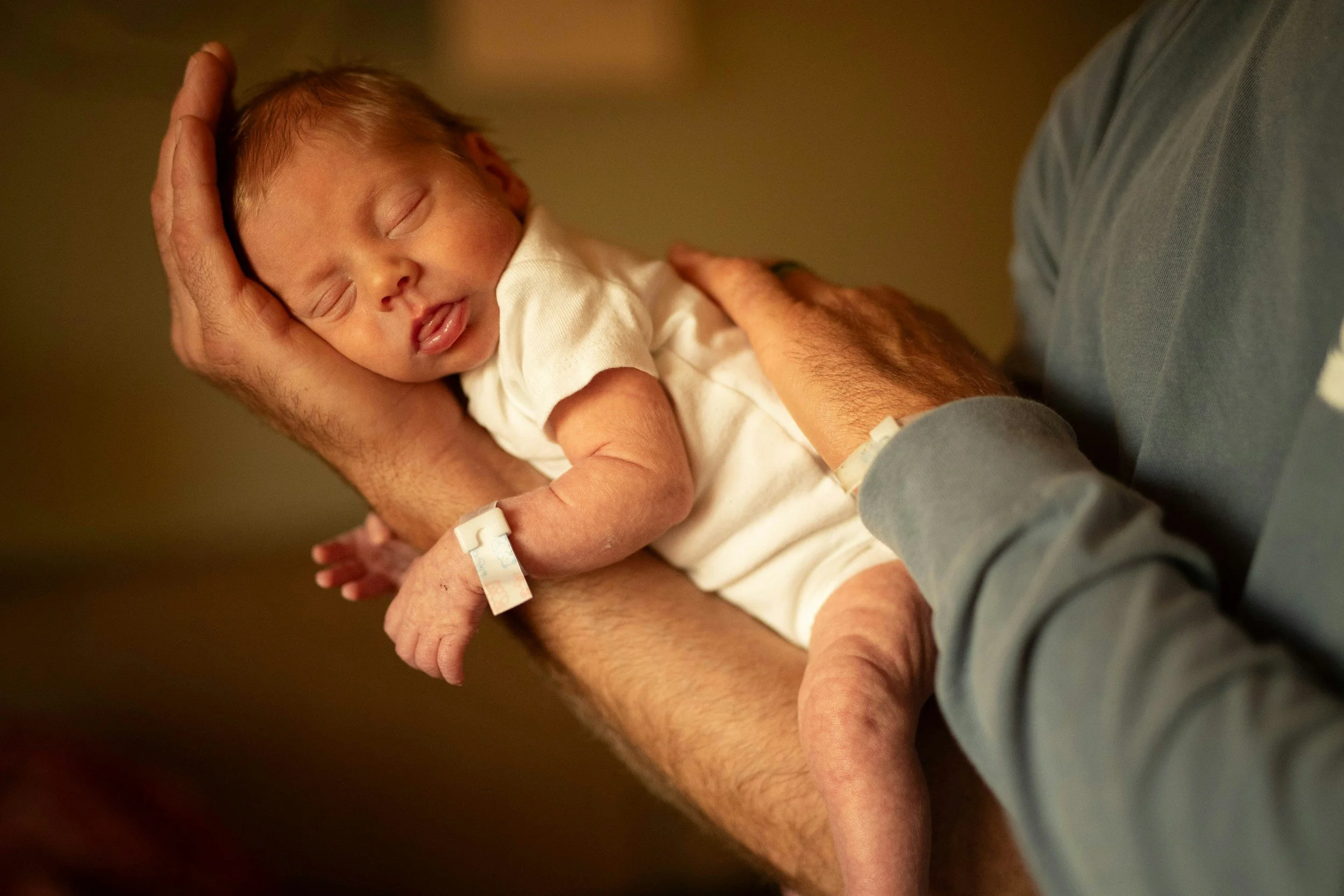
Most newborns sleep through it. Some fuss because a baby that age would rather not be held still, and that settles as soon as they are back on your shoulder.
Babies who are rolling, sitting, and crawling
Once a baby starts moving, the nervous system gets a flood of new information. Every roll, every push up onto the hands, every wobble teaches the brain where the body is in space.
At this stage we pay close attention to how a baby moves, how they hold their head and neck, and whether they turn as easily one way as the other.
The adjustment stays just as gentle. What changes is that we are now working with a moving target, so the visit happens wherever the baby is happiest. On the floor. On your lap. Over your shoulder. We follow the baby.
Toddlers who never hold still
Toddlers are a different sport. They are busy, they have strong opinions, and they fall down all day long. That is normal toddler life, and it is also a steady pile of small physical load.
Toddler visits are short and quick on purpose. Ten to fifteen minutes is common. Pressure is still light and still specific to what we measured.
Here is the part parents tell us they did not expect. By the third or fourth visit, most toddlers walk themselves back to the table. They have figured out that it does not hurt and that it is over fast.
School-age kids in Petaluma and Sonoma County
By five or six, the load on a kid’s system changes shape. Now there are backpacks, desks, screens, homework, early practices, and a schedule that belongs to somebody else.
Think of the brain and spinal cord as Highway 101, and the nerves as all the on ramps and off ramps that feed it. School-age life adds traffic. Our job is to find the place where traffic is backed up, and clear it.
A school-age visit looks a lot like a grown-up visit, scaled down. The child can tell us what they notice, which helps. We use the Zone Technique head check, which is six quick contact points on the head that tell us which of the six zones in the body is asking for attention. Then we adjust the matching spinal points, and your child goes home with a Zone Slip so you know exactly what we found that day.
Teenagers
Teens carry adult-sized load in a body that is still being built. Growth spurts, sports, long practices, phones, late nights, and real stress about grades and friendships all land on the same nervous system.
A teen visit is close to an adult visit with one important difference. We talk to the teen, not around them. They answer their own questions and tell us what they are feeling. Most teens like that part more than they let on.
Pressure goes up a little as a body gets bigger. Gentle and specific is still the rule. Strong. Clear. Unshakable.
What the scans show at every age
We don’t guess. We test, adjust, and retest. That holds whether the patient is six days old or sixteen years old, because we check everyone with the same INSIGHT scanning technology.
There are three scans. All three are comfortable and quiet, with no needles and no radiation.
neuroCORE measures the electrical activity moving along the spine. It shows us where nerve energy is running high, low, or unevenly from one side to the other.
neuroTHERMAL reads the heat pattern down the spine. Those readings come from the automatic nerves, the ones that run organs and glands in the background without anyone thinking about it.
neuroPULSE looks at the rhythm of the heartbeat. This is the one that shows us the gas pedal and the brake. Some nervous systems sit with the gas pedal pressed down and the brake barely working.
All three fold into one number called the CORESCORE, on a scale of zero to one hundred. The first scan is the starting line. The re-scan a few weeks later is the proof. If the numbers move, the body did that work. We simply cleared the way.

Little kids get the same three scans as adults. The sensors are small, the whole thing takes a few minutes, and most toddlers think it tickles.
What stays the same from newborn to teen
Four things never change, no matter the age on the chart.
We look at the nervous system first. We scan before we adjust, and we scan again later. The adjustment is gentle and specific to what the scan actually showed. You go home knowing exactly what we found.
That is why family chiropractic care here tends to turn into a rhythm rather than a single visit. A family grows. Life keeps adding load. The nervous system keeps needing a clear signal. Redwoods add a ring every single year, and that steady rhythm is what makes them unshakable.
Is this you?
Maybe you have a newborn at home and you have been wondering all week whether someone that small can even be checked. Maybe you have a nine-year-old who seems to carry the whole school year in their shoulders. Maybe you have a teen athlete and you would like to know what their nervous system is actually doing underneath all that training.
If any of that sounds like your house, schedule a visit or give us a call at 707-242-6624. We will start exactly where you are. You can also read what to expect before you come, so nothing about the first visit is a surprise.
Come see us in Petaluma
We check and adjust babies, kids, teens, and parents every day for families in Petaluma, Penngrove, Cotati, Rohnert Park, and throughout Sonoma County and the North Bay. Built like a Titan.
Titan Chiropractic, 1476 Professional Dr, Petaluma, CA 94954. Neurologically focused prenatal, pediatric, and family chiropractic for Petaluma, Penngrove, Cotati, and Sonoma County. We don’t guess. We test, adjust, and retest.
Ready to Start Your Healing Journey?
Our Titan Chiropractic family is here to support you and your loved ones with compassionate, nervous system-based care.
Book Your First Visit